
Choosing the right crochet hook can be confusing when you’re just starting. Crochet hooks come in many different sizes, and the size you need depends on the yarn, the project, your tension, and the pattern you’re following.
Using the wrong hook can make your stitches too tight, too loose, or cause your finished project to be a completely different size than expected.
In this guide, we’ll explain crochet hook sizes, how crochet hook sizing works, how to choose the right hook for your yarn, and what beginners should know before starting a project.
What Do Crochet Hook Sizes Mean?
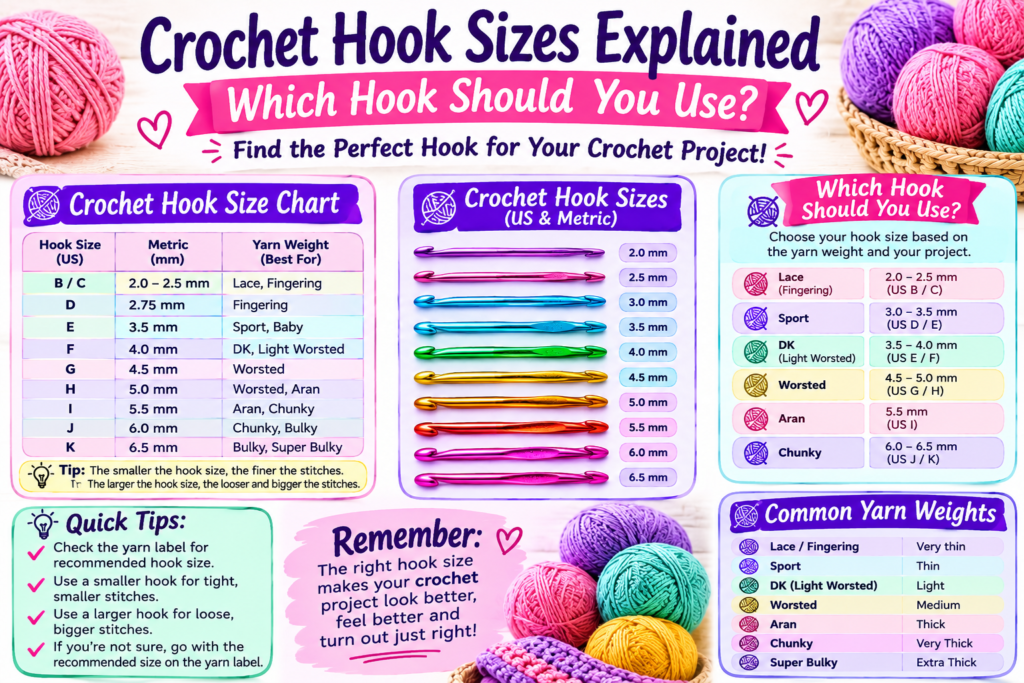
A crochet hook size refers to the diameter of the hook’s shaft, usually measured in millimeters.
For example:
- 2.5 mm = small hook
- 4 mm = medium-small hook
- 5 mm = medium hook
- 6 mm = larger hook
- 10 mm = very large hook
Generally, the larger the number in millimeters, the larger the hook.
A larger hook usually creates larger and looser stitches, while a smaller hook creates smaller and tighter stitches.
Common Crochet Hook Sizes
Here is a simple reference for some commonly used crochet hook sizes:
| Hook Size | Common Uses |
|---|---|
| 2.0–2.5 mm | Fine yarn, small crochet details |
| 3.0–3.5 mm | Lightweight projects |
| 4.0–4.5 mm | Light to medium yarn |
| 5.0 mm | Medium-weight yarn and beginner projects |
| 5.5–6.5 mm | Chunkier projects |
| 7.0–9.0 mm | Bulky yarn |
| 10 mm+ | Super bulky yarn and large projects |
These are general guidelines, not strict rules. Always check your yarn label and pattern recommendations.
How to Choose the Right Crochet Hook
The easiest way to choose a crochet hook is to start with the yarn label.
Most yarn manufacturers provide a recommended hook size on the label.
For example, a medium-weight yarn might recommend a hook somewhere around 4.5–5.5 mm.
If you’re following a crochet pattern, however, the pattern’s recommended hook should usually be your starting point.
Remember:
Yarn label + pattern recommendation + your tension = the best hook choice.
Crochet Hook Size and Yarn Weight
Yarn comes in different weights, from very fine yarn to extremely bulky yarn.
As a general rule:
Thinner yarn → smaller hook
Thicker yarn → larger hook
For example, delicate lace yarn generally requires a much smaller hook than super bulky yarn.
However, there’s some flexibility depending on the project.
A designer might intentionally use a larger hook with medium-weight yarn to create a loose, open fabric.
What Happens If Your Hook Is Too Small?
Using a hook that’s too small for your yarn can make your stitches very tight.
You may notice:
- Difficulty inserting the hook
- Stiff fabric
- Very small stitches
- Hand fatigue
- A finished project smaller than expected
If your stitches feel extremely difficult to work, try going up a hook size.
What Happens If Your Hook Is Too Large?
A hook that’s too large can create very loose stitches.
Your project may become:
- Floppy
- Very open
- Larger than expected
- Difficult to shape
A larger hook isn’t necessarily wrong—it depends on the look you’re trying to achieve.
For example, a large hook can be useful when creating a loose, drapey fabric.
Why Your Crochet Hook Size May Be Different From Someone Else’s
Two people can use the exact same yarn and hook but produce slightly different results.
Why?
Because everyone’s crochet tension is different.
One person may naturally crochet tightly, while another may crochet loosely.
This is why the recommended hook size should be considered a starting point rather than an absolute rule.
Understanding Gauge
If you’re making something where the finished size matters, checking your gauge is extremely important.
A pattern may specify something like:
16 stitches × 12 rows = 4 inches
You make a small gauge swatch and measure it.
If you have too many stitches in the same space, your stitches are probably too small or tight. You may need a larger hook.
If you have too few stitches, your stitches may be too large or loose. You may need a smaller hook.
Simple rule:
Too many stitches → try a larger hook.
Too few stitches → try a smaller hook.
Which Crochet Hook Size Is Best for Beginners?
If you’re just learning crochet, a 5 mm crochet hook is a great size to practice with when paired with an appropriate medium-weight yarn.
It’s large enough to make stitches easy to see without being unnecessarily bulky.
A smooth, medium-weight yarn combined with a 5 mm hook can be a comfortable setup for practicing basic stitches such as:
- Chain stitch
- Single crochet
- Half double crochet
- Double crochet
Once you’re comfortable, you can experiment with smaller and larger hooks.
Different Types of Crochet Hooks
Hook size isn’t the only thing to consider. Crochet hooks are also available in different materials and designs.
Aluminum Hooks
Aluminum hooks are common and allow yarn to slide relatively easily.
They’re widely available and are a good option for beginners.
Ergonomic Hooks
Ergonomic hooks have specially designed handles intended to make crocheting more comfortable.
They can be particularly helpful if you spend long periods crocheting.
Plastic Hooks
Plastic hooks are lightweight and often inexpensive.
They’re available in a variety of sizes and can be useful for larger hooks.
Steel Hooks
Steel crochet hooks are generally used for very fine crochet work and thread.
They’re much smaller than the hooks most beginners use for standard yarn.
Does Crochet Hook Shape Matter?
Yes. Different hooks can have slightly different shapes, including differences in the head, throat, and handle.
Two hooks with the same millimeter size can sometimes feel different in your hand.
If you’re struggling with a particular hook, don’t assume you’re doing something wrong. Another hook style may simply feel more comfortable for your technique.
Should You Buy a Complete Crochet Hook Set?
Beginners don’t necessarily need a huge collection of hooks immediately.
Instead, consider starting with a few common sizes such as:
- 4 mm
- 5 mm
- 5.5 mm
- 6 mm
As you work with different yarns and patterns, you can gradually add more sizes to your collection.
A complete set can be useful later, but there’s no need to buy every size before you’ve learned what you actually enjoy crocheting.
Final Thoughts
Understanding crochet hook sizes makes choosing your materials much easier.
As a beginner, start by checking your yarn label and the crochet pattern you’re following. Then consider your personal tension and, when necessary, make a gauge swatch to determine whether you need a different hook.
Most importantly, don’t feel like you have to use one specific hook size forever. Experimenting with different sizes is part of learning crochet.
Once you understand how hook size affects your stitches, you’ll have much more control over the look, feel, and size of your crochet projects.