
Starting crochet can feel a little confusing at first. You have to learn how to hold the hook, control the yarn, make stitches, read patterns, and keep your tension consistent—all at the same time.
But don’t worry. You don’t need to master everything immediately. With a few simple crochet tips for beginners, you can make the learning process much easier and more enjoyable.
Whether you’re picking up a crochet hook for the first time or still struggling with your first few projects, these 10 essential tips will help you build better habits from the beginning.
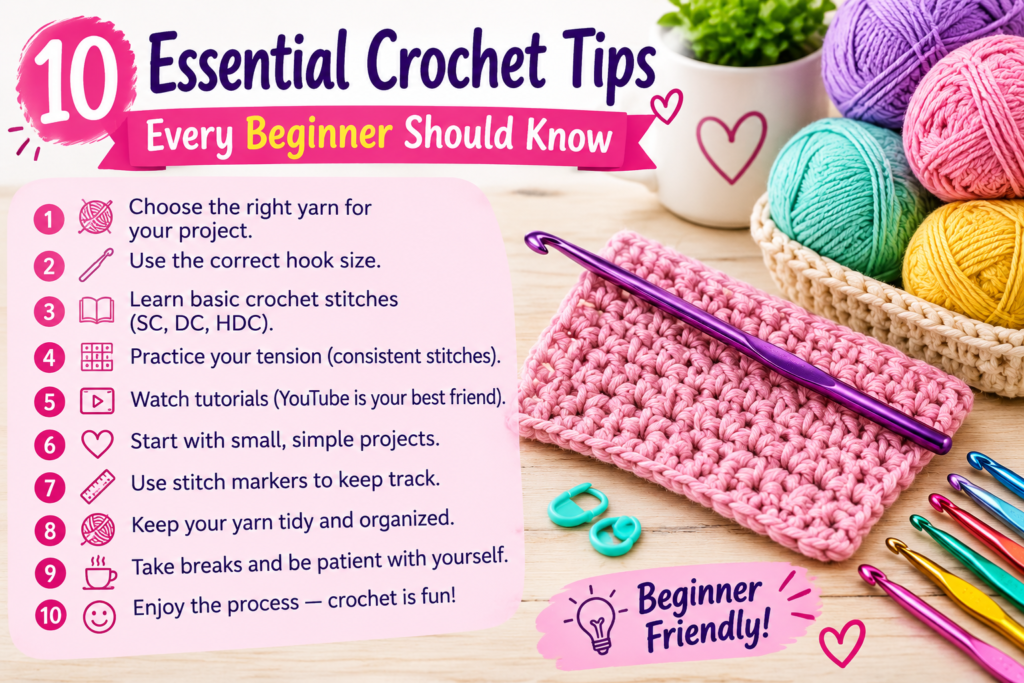
1. Start With the Basic Crochet Stitches
Before jumping into complicated patterns, take some time to learn the fundamental crochet stitches.
The most useful stitches for beginners include:
- Chain stitch
- Slip stitch
- Single crochet
- Half double crochet
- Double crochet
- Treble crochet
Once you understand these basic stitches, you’ll be able to follow a much wider variety of crochet patterns.
Beginner tip: Don’t try to learn everything in one day. Practice one or two stitches until they feel comfortable before moving on.
2. Choose Beginner-Friendly Yarn
The yarn you choose can make a big difference when you’re learning.
Very thin yarn can make your stitches difficult to see, while extremely thick or fuzzy yarn can make it harder to understand where to insert your hook.
For beginners, a medium-weight yarn with a smooth texture is usually a good choice.
Light or medium-colored yarn is also easier to work with because you can clearly see your stitches.
Avoid: Very dark, fuzzy, or highly textured yarn when you’re still learning the basics.
3. Use the Correct Crochet Hook Size
Every yarn has a recommended crochet hook size, which is usually printed on the yarn label.
Using the right hook makes it easier to create comfortable, consistent stitches.
If your hook is too small, your stitches may become extremely tight. If it’s too large, your stitches may become loose and difficult to control.
Beginner tip: Start with the hook size recommended on your yarn label, then adjust it if your pattern requires a different size.
4. Don’t Pull Your Yarn Too Tightly
One of the most common beginner crochet problems is holding the yarn too tightly.
When your tension is too tight, your hook can become difficult to insert into stitches, and your hands may become tired.
Try to let the yarn flow naturally through your fingers instead of gripping it tightly.
Your goal is to create consistent tension, not extremely tight stitches.
5. Count Your Stitches Regularly
Losing stitches is one of the easiest ways for a crochet project to become the wrong shape.
For example, you might begin a row with 20 stitches but accidentally finish with 18.
To prevent this, count your stitches regularly.
For beginner projects, it can be helpful to count your stitches at the end of every row.
Helpful tip: Use stitch markers to identify important stitches, especially the first and last stitch of a row.
6. Learn How to Read a Crochet Pattern
Crochet patterns may look confusing when you first see abbreviations such as:
- ch = chain
- sc = single crochet
- hdc = half double crochet
- dc = double crochet
- sl st = slip stitch
- inc = increase
- dec = decrease
You don’t need to memorize all of them immediately.
Keep a crochet abbreviation guide nearby and check unfamiliar terms as you work.
Also, read the entire pattern before starting. This can help you understand what materials, stitches, and techniques you’ll need.
7. Practice Your Tension
Tension is one of the most important skills to develop as a new crocheter.
If your tension changes constantly, your project can become uneven or end up a completely different size than expected.
A simple way to practice is to crochet small squares or rows without worrying about making a finished project.
Focus on making your stitches look as similar as possible.
Remember: Your tension will naturally improve with practice. Don’t expect perfect stitches on your first day.
8. Use Stitch Markers
Stitch markers are small but incredibly useful crochet tools.
They can help you:
- Mark the beginning of a round
- Identify the first stitch
- Keep track of increases and decreases
- Prevent losing your place
- Count sections of a project
If you don’t have traditional stitch markers, you can temporarily use a small piece of contrasting yarn or another suitable marker.
For beginners, stitch markers can save a lot of frustration.
9. Don’t Be Afraid to Undo Your Stitches
This is an important lesson for every new crocheter: it’s okay to unravel your work.
If you notice that you skipped a stitch several rows ago, continuing may make the problem worse.
Instead, carefully undo your stitches until you reach the mistake and crochet the section again.
This process is often called frogging, and even experienced crocheters do it.
Don’t think of unraveling as failure. It’s simply part of learning and correcting your work.
10. Practice Consistently Instead of Trying to Be Perfect
You don’t need to crochet for hours every day to improve.
Even 15–30 minutes of regular practice can help you become more comfortable with your hook, yarn, stitches, and tension.
Instead of focusing on making a perfect first project, focus on improving one skill at a time.
For example:
Week 1: Practice chains and single crochet.
Week 2: Practice double crochet and turning chains.
Week 3: Practice keeping your tension consistent.
Week 4: Try a simple beginner-friendly project.
The more you practice, the more natural crochet will feel.
Final Thoughts
Learning crochet takes patience, but you don’t have to figure everything out at once. Start with the basics, choose easy-to-see yarn, use the appropriate hook, and practice keeping your tension consistent.
Most importantly, don’t be discouraged by mistakes. Dropped stitches, uneven rows, and unraveling your work are all normal parts of learning.
With regular practice and a little patience, you’ll gradually develop the confidence to move from simple beginner projects to more advanced crochet techniques.