
Crochet is one of those crafts that looks complicated at first but becomes much easier with practice. If you’re just starting, making mistakes is completely normal. Even experienced crocheters occasionally lose a stitch, misread a pattern, or end up with edges that don’t quite look right.
The good news is that most common crochet mistakes are easy to prevent once you know what to look for.
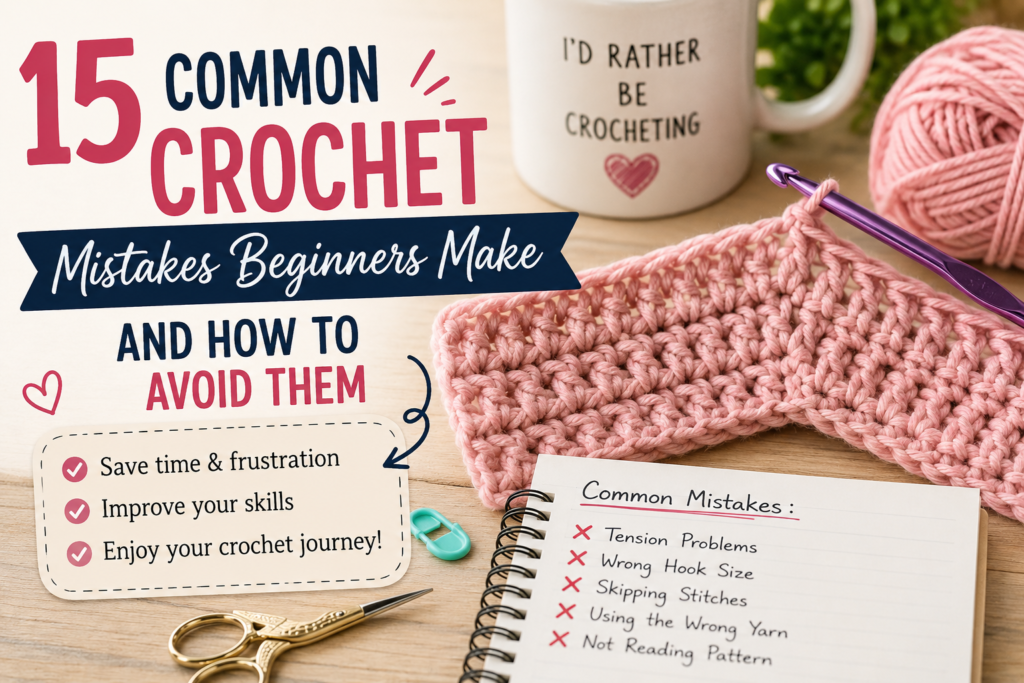
In this guide, we’ll cover 15 beginner crochet mistakes, why they happen, and simple ways to avoid them so you can crochet with more confidence.
1. Using the Wrong Crochet Hook Size
One of the first mistakes beginners make is choosing a crochet hook without checking the recommended size for their yarn.
Using a hook that’s too small can make your stitches tight and difficult to work into. A hook that’s too large can create loose, floppy stitches.
How to avoid it:
Check the yarn label for the recommended crochet hook size. If you’re following a pattern, use the hook size suggested by the designer as your starting point.
2. Holding the Yarn Too Tightly
Many beginners naturally hold the yarn tightly because they want their stitches to look neat. However, excessive tension can make crochet uncomfortable and cause very tight stitches.
How to avoid it:
Try to keep your hands relaxed and allow the yarn to move smoothly through your fingers. Your goal is consistent tension, not maximum tightness.
3. Making Your Tension Inconsistent
Tension refers to how tightly or loosely you make your stitches. If your tension changes throughout a project, your finished piece can become uneven or change size.
How to avoid it:
Practice making several rows while concentrating on keeping your stitches similar in size. With time, consistent tension will become much more natural.
4. Losing or Adding Stitches
This is one of the most frustrating problems for beginners. You start with 20 stitches, work several rows, and suddenly you have 18 or 23.
Usually, the problem comes from accidentally skipping a stitch or crocheting into the wrong place.
How to avoid it:
Count your stitches at the end of every row, especially when you’re learning. Stitch markers can also help you identify the first and last stitch.
5. Not Counting the Turning Chain Correctly
Turning chains can be confusing because their role depends on the stitch and pattern you’re working with. Sometimes the turning chain counts as a stitch, and sometimes it doesn’t.
How to avoid it:
Always check the pattern instructions before starting a new row. If the turning chain counts as a stitch, remember to account for it when counting your stitches.
6. Crocheting Into the Wrong Part of the Stitch
A crochet stitch has different loops, and beginners can easily insert the hook into the wrong place.
This can change the appearance and shape of your project.
How to avoid it:
Before starting, look carefully at where your pattern tells you to insert the hook. When you’re unsure, stop and identify the top loops of the stitch before continuing.
7. Skipping the First or Last Stitch
The first and last stitches of a row can be particularly difficult to see. Missing one can gradually make your project narrower.
How to avoid it:
Use a stitch marker to identify the first stitch of each row. When you reach the end, make sure you’re working into the correct final stitch before turning.
8. Not Checking Your Gauge
Gauge is the number of stitches and rows produced within a specific measurement. Beginners often skip the gauge swatch because they want to start their project immediately.
But if your gauge is different from the pattern’s gauge, your finished project may be much larger or smaller than expected.
How to avoid it:
For projects where size matters, make a gauge swatch before starting. Adjust your hook size if necessary.
9. Choosing Difficult Projects Too Early
It’s tempting to start with an advanced blanket, complicated amigurumi, or intricate lace design. However, a difficult first project can quickly become frustrating.
How to avoid it:
Start with basic projects that allow you to practice fundamental stitches such as single crochet, half double crochet, and double crochet.
10. Not Understanding Crochet Abbreviations
Crochet patterns often use abbreviations such as sc, dc, hdc, ch, sl st, and inc. Seeing these for the first time can feel like reading another language.
How to avoid it:
Keep a crochet abbreviation guide nearby while you’re learning. Before starting a pattern, read through the instructions and make sure you understand the stitches being used.
11. Pulling the Slip Knot Too Tight
A slip knot is usually one of the first things you learn, but pulling it too tightly can make the first crochet stitches difficult to work into.
How to avoid it:
Make the slip knot secure but leave enough room for your hook to move comfortably through the loop.
12. Forgetting to Turn Your Work Properly
When crocheting rows, beginners sometimes turn their work without following the pattern’s instructions or accidentally work in the wrong direction.
How to avoid it:
At the end of each row, follow the pattern carefully: complete the final stitch, make the required turning chain, and then turn your work.
13. Not Weaving in Yarn Ends Properly
After finishing a project, you may have several loose yarn tails. Simply cutting them close to the project can cause your work to unravel over time.
How to avoid it:
Use a yarn needle to weave the ends securely through several stitches. Then trim the excess yarn.
14. Giving Up When Something Looks Wrong
This is perhaps the biggest beginner mistake.
You may notice that a row looks uneven or that your project isn’t the same size as the pattern. Many beginners assume they’ve completely failed and stop.
How to avoid it:
Stop and investigate the problem. Count your stitches, compare your work with the pattern, and look at the previous rows. Crochet mistakes are often much easier to fix than they initially appear.
15. Comparing Your Work to Experienced Crocheters
Social media is full of beautiful crochet projects made by people who have been crocheting for years. Comparing your first project to someone’s 100th project can make you feel discouraged.
How to avoid it:
Focus on your own progress. Your stitches will become more consistent, your tension will improve, and complicated techniques will become easier with practice.
Final Thoughts
Making mistakes is a normal part of learning crochet. The important thing isn’t to avoid every mistake—it’s to learn how to recognize and fix them.
Start with simple projects, practice your tension, count your stitches, and don’t be afraid to undo a few stitches when something doesn’t look right. With regular practice, many of these beginner crochet problems will eventually disappear naturally.
Most importantly, give yourself time to improve. Every experienced crocheter was once a beginner struggling with their first chain and wondering why their project wasn’t the right shape.